Markets Now Veto Trade Wars in Real Time
The Stock Market's New Job: Killing Tariffs Before They Start

Donald Trump threatened tariffs on Greenland on a Tuesday. By Wednesday, he was at Davos announcing what he called “the framework of a future deal” that scrapped them entirely. One trading day. That is how long the threat survived contact with a market that did not like the direction of travel.
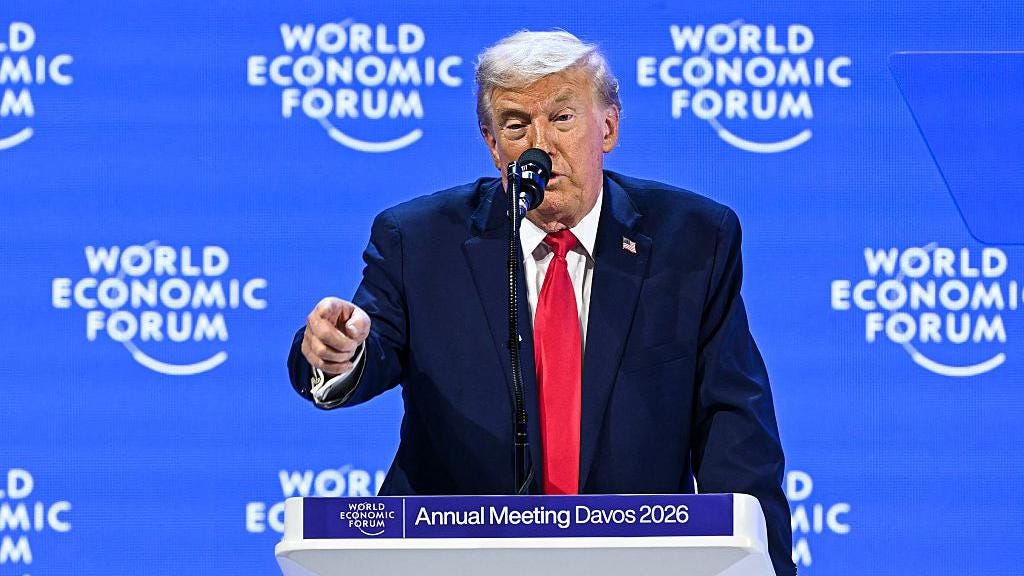
At Davos, Trump tried to explain the pivot while repeatedly calling Greenland “Iceland”, and at one point blamed the market move on it: “our stock market took the first dip yesterday because of Iceland”. The gaffe was funny in the way gaffes often are: a small slip that exposes a bigger truth. What mattered was not the geography. It was the admission that a dip in equities had become a policy input.
I have spent the past week reconstructing the timeline around the Greenland threat and then laying it beside two other episodes that hit markets at roughly the same time: a genuinely violent swing in Japanese government bonds, and a U.S. jobs print that looked recessionary until you adjusted for a changed labor-force reality. Add a fourth strand, the Davos warning from Mark Carney that allies are already hedging their U.S. exposure, and a fifth, Ken Griffin’s skepticism about AI exuberance, and a pattern starts to harden.
The pattern is not “Trump is dovish now.” It is more specific. Markets are functioning as a binding constraint on trade-war escalation, and the administration’s revealed pain threshold appears lower than its rhetoric implies. To understand what that means going forward, you have to see how fast the constraint is tightening, and how it collides with the legal constraints on tariff authority that are now moving toward the Supreme Court.
The Pattern of Market-Driven Reversals
The Greenland episode was not just a reversal. It was a reversal at speed.
When Trump stood up in Davos, the language had already shifted from coercion to permanence and partnership. He said:
“We have formed the framework of a future deal with respect to Greenland... This solution, if consummated, [achieves goals] forever.”
That is not how leaders talk when they are trying to keep a tariff threat credible. It is how leaders talk when they want to declare the dispute resolved and move on. And it happened in a single trading day, which is what makes Greenland analytically useful. It compresses a broader dynamic into a clean, observable unit: threat, market reaction, retreat.
The Danish response was equally revealing, not because it was dramatic, but because it was immediate and pragmatic. Danish Foreign Minister Lars Løkke Rasmussen welcomed the opening and made clear Denmark understood what the White House was signaling. He said:
“Now, let’s sit down and find out how we can address the American security concerns.”
That line matters because it shows how counterparties read the moment. Denmark did not respond as if it had just survived a serious attempt at economic coercion. It responded as if the coercion had been downgraded into a bargaining chip, and the sensible move was to lock in a negotiation while Washington was in a conciliatory posture.
The market sensitivity was not subtle. Trump’s own explanation, delivered amid the “Iceland” mix-up, explicitly tied the reversal to equities. The AP News account that he referred to Greenland as Iceland four times, while complaining that “our stock market took the first dip yesterday because of Iceland,” is not just a funny footnote. It is a behavioral tell. When a president publicly narrates policy in terms of yesterday’s stock tape, markets stop being an audience and become a participant.
I kept coming back to an earlier episode that traders still shorthand as “Liberation 1.0”: tariffs that were paused after roughly two weeks of market bleeding. The details of that period matter less than the cadence. Back then, the administration could endure a couple of weeks of negative feedback before stepping back. With Greenland, the timeline compressed from weeks to a day.
That acceleration is the story.
In trade policy, credibility is often treated as a function of legal authority and political will. The Greenland reversal suggests a third input has become decisive: how quickly markets punish the attempt. When the punishment arrives fast enough, the policy window closes before the threat can mature into leverage.
This is not a claim about Trump’s psychology. It is a claim about revealed constraints. The White House can still threaten tariffs. What looks less durable is the willingness to absorb the market drawdown that makes those threats believable.
And once counterparties learn that, they adapt. Denmark’s posture, “let’s sit down,” reads like a country trying to convert a moment of U.S. retreat into a structured process that reduces the odds of a future surprise.
That raises the next question I had to answer for myself: if markets are a constraint, what happens when the market constraint runs into legal constraints on tariff authority?
The Legal Architecture of Tariff Threats
There is a temptation to treat tariffs as a single tool: the president wants tariffs, the president imposes tariffs. In reality, tariff threats are shaped by a patchwork of legal authorities, each with its own triggers, timelines, and vulnerabilities.
The most important near-term vulnerability is hanging over the administration’s preferred mechanism. Tariffs imposed under IEEPA are heading toward the Supreme Court, with arguments scheduled for January 2026, and legal experts signaling a high likelihood of invalidation as noted by SCOTUSblog. The Peterson Institute has also warned that applying IEEPA tariffs on allies in a Greenland-linked context faces significant constitutional hurdles in its analysis.
I cannot tell you with certainty how the Court will rule. Nobody can, and honest observers disagree because the legal questions mix national-security deference with separation-of-powers doctrine in a way that resists clean prediction. But the direction of travel is clear enough to affect behavior now: if the core authority is at risk, the administration has to think about substitutes.
Two substitutes matter because they are real, but they are not interchangeable.
Section 122 is the fastest “legal” tariff lever in the background. It allows tariffs up to 15% for 150 days in a balance-of-payments context, a framework summarized in trade enforcement guidance from the U.S. Department of Commerce. The key feature is speed. The key limitation is duration and scope. A 150-day clock is not how you run an extended trade war. It is how you apply pressure quickly while you look for a longer bridge.
That bridge is often imagined as Section 232, the national security tariff authority. But 232 is not fast. It requires a Commerce Department study, and the guidance lays out a timeline of roughly 150 to 270 days in the Commerce Department’s Section 232 process overview. In plain English: half a year to most of a year, plus the need to justify the move as national security.
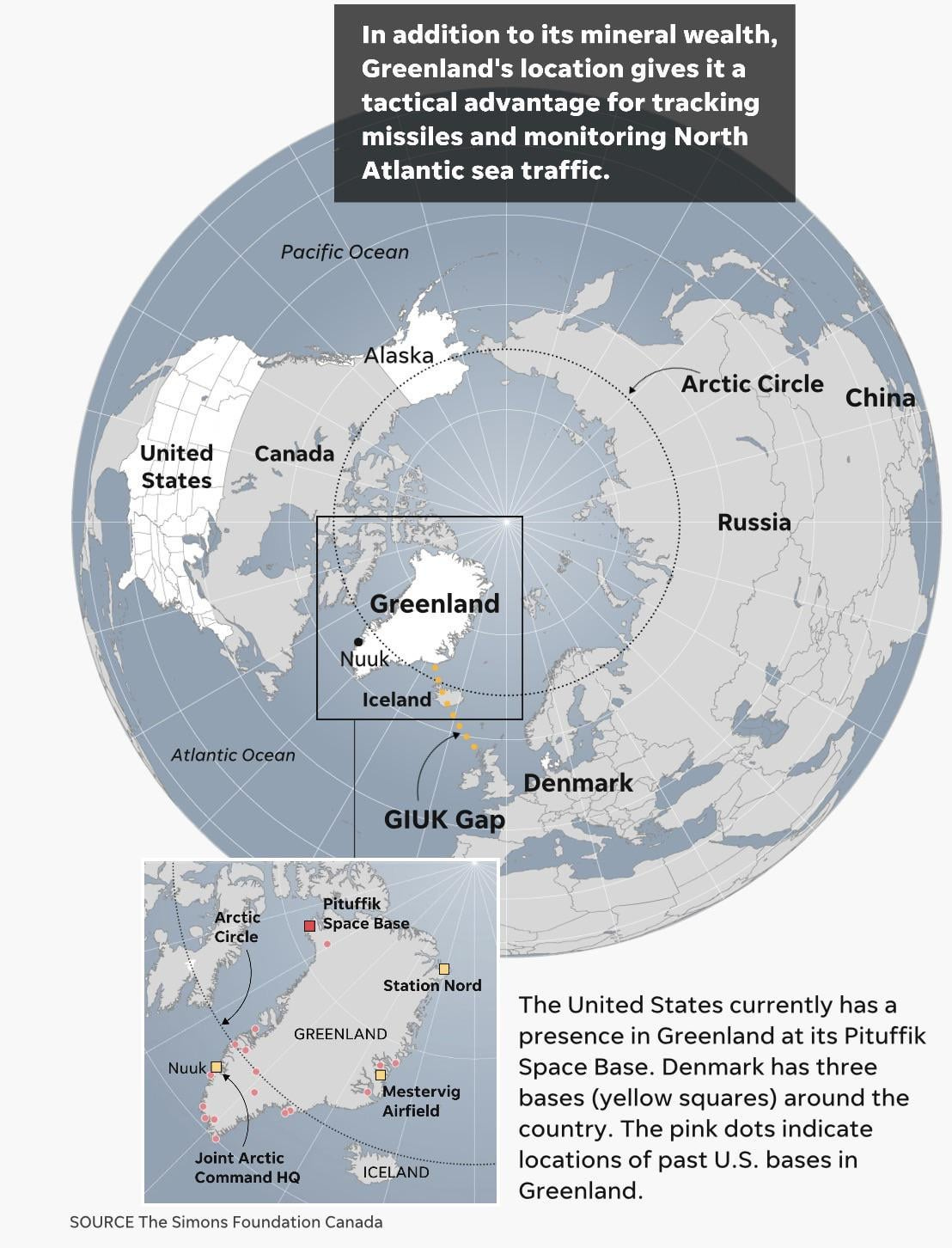
This is where Greenland becomes more than a one-day anecdote. Greenland sits at the intersection of security arguments and alliance politics. In theory, it could have provided a rhetorical runway for a national-security framing that might have been used to justify a slower-moving tariff architecture. In practice, the reversal short-circuited that runway.
If you believe the administration wants escalation, legal constraints now matter more because the fast authority is legally shaky and the slow authority is slow. If you believe the administration does not want escalation, legal constraints matter because they further narrow the set of credible threats.
Either way, Greenland’s one-day retreat is not just a sign of market sensitivity. It also narrows the menu of escalation paths that can be executed quickly and credibly.
And markets are not only reacting to tariff policy. The same week showed how quickly global bond markets can move, and then recover, when fear spikes and then finds a floor.
The Japanese Bond Stress Test
If you want to understand what “market constraint” looks like in real time, watch the bond market when it gets scared.
On January 20, Japanese 10-year yields rose 19 basis points, the sharpest move since 2022, and Reuters described it as a sixth standard deviation event. That is black-swan language, the kind of statistical description people reach for when a move is so large it is supposed to be rare on any normal distribution.
I do not use “six sigma” casually. When rates markets move like that, the first-order fear is not “Japan is repricing.” The fear is plumbing: forced selling, collateral calls, risk-parity deleveraging, and the possibility that a sharp move in a major sovereign market spills into global duration and then into equities.
Then something important happened. The panic did not compound.
Bloomberg reported that Japanese bonds rebounded within 24 hours after officials called for market calm. In other words, an event that looked like the start of a disorderly unwind snapped back quickly once the system got a signal that policymakers were watching the tape and were willing to lean against disorder.
This is where the Greenland parallel is useful. In both cases, you saw a sudden stressor, a sharp market reaction, and then a rapid normalization. The stress was real. The speed of the resolution was also real.
I’m not claiming this means “no recession” or “no crisis.” Bond markets can calm down and still be right about slower growth later. But I am saying the week’s pattern points to something specific: the system is now highly reflexive. Policymakers react to market moves quickly, and markets, in turn, learn that policymakers are watching the same screens.
That reflexivity has a practical implication for how investors interpret shocks. Some shocks are signals of a durable regime shift. Others are stress tests that clear quickly and leave behind information about where the policy reaction function sits. Japan looked like the latter.
And the labor data tells a similar story: a number that looks alarming until you adjust for the new baseline.
Labor Data Through the Immigration Lens
The ADP National Employment Report showed that private sector employment increased by 41,000 jobs in December, and that annual pay was up 4.4%. On the surface, 41,000 is the kind of number that triggers recession talk, especially for anyone anchored to the old post-pandemic rhythm where monthly job gains often printed in the 150,000 to 200,000 range.
But the labor market is not the same machine it was when those baselines were set. Immigration inflows have changed, which changes labor-force growth, which changes the monthly job creation needed to keep unemployment stable.
The reframe that matters is the “break-even” concept: roughly how many jobs per month the economy needs to add to absorb new entrants and keep employment conditions from deteriorating. With reduced immigration inflows, that break-even is now approximately 20,000 to 35,000 jobs per month, rather than the prior 150,000 to 200,000 baseline.
Under that lens, 41,000 is not a boom. But it is also not a collapse. It is above the new stability threshold.
The wage number matters too. Annual pay up 4.4% is not what you expect to see if the labor market is falling apart in real time. Wage growth can lag, and it can be sticky, but it is still a useful check against the most alarmist interpretations of a weak headline employment print.
I do not want to overstate the comfort here. A labor market can cool gradually and still produce weak growth outcomes. But the point of this section is narrower: the data is consistent with normalization, not necessarily with recession.
So, in one week, I saw tariff threats reversing, bond stress resolving, and labor data that looked “bad” until you adjusted for changed conditions. That combination is the short-term relief narrative.
But not everyone is buying it. And the most interesting dissent I heard at Davos was not a trader’s hot take. It was a warning about how allies respond when the U.S. treats its relationships like a revenue line.
The Diversification Warning
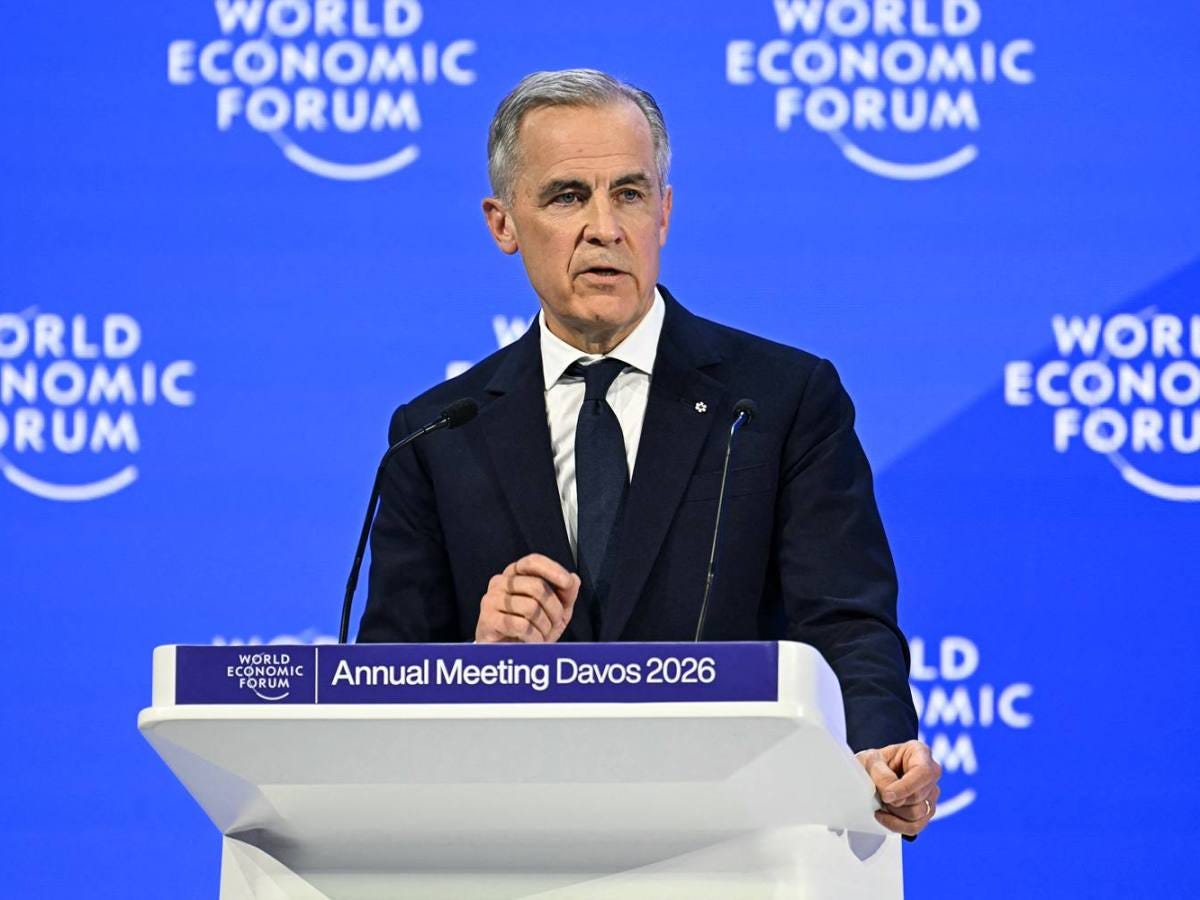
Mark Carney’s Davos message landed because it did not sound like a speech written to flatter anyone. It sounded like a diagnosis of a system drifting into a new kind of fragmentation.
He put the core idea in a sentence that was almost too clean:
“Hegemons cannot continually monetize their relationships. Allies will diversify to hedge against uncertainty.”
That is the counterweight to the Greenland relief rally mindset, as stated in Carney’s Davos 2026 address published by the World Economic Forum. Carney is not saying allies will break with the U.S. tomorrow. He is saying the incentives have shifted. If the U.S. is willing to use tariffs and financial leverage as negotiating tools, then even close partners will start to ask what it means to be overexposed to U.S. assets and U.S.-controlled channels.
The scale of that exposure is not abstract. Reuters, citing Deutsche Bank analysis, put a number on it: Europeans hold approximately $8 trillion in U.S. assets. That figure is the kind of thing that looks stable until it is not, because the marginal seller sets price in stressed moments.
This is where the story gets tense in a way that is more revealing than any single market move.
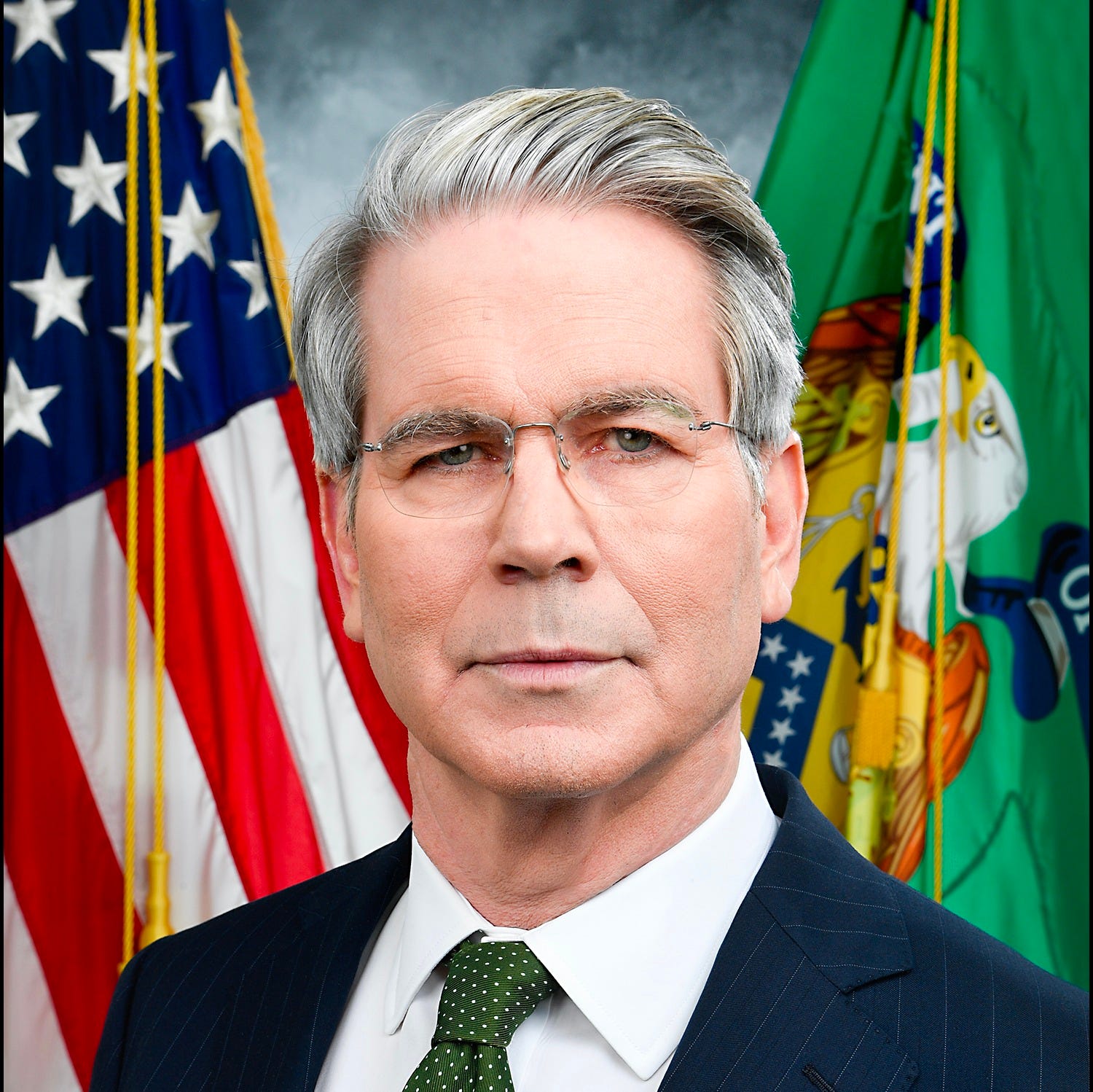
At Davos, a Deutsche Bank analyst report suggested a scenario of European asset dumps. The report itself was not the point. The point was the reaction. Treasury Secretary Scott Bessent said Deutsche Bank CEO Christian Sewing called him to distance the bank from it, and Bessent relayed the message in blunt terms:
“Deutsche Bank does not stand by that analyst report.”
I read that as institutional fear of being seen as the one to say the quiet part out loud. Carney can warn about diversification in a keynote. A major bank, with a big U.S. footprint and regulatory relationships to manage, scrambles to disavow even the suggestion that diversification could become an active trade.
That contradiction matters. It tells me the diversification conversation is happening, but it is politically radioactive. And when a topic becomes radioactive, it often means it is close to a real pressure point.
Gold is the simplest real-time proxy for that pressure because it is the hedge people buy when they do not want to name what they are hedging. During the same Davos stretch, gold prices were at all-time highs. AP News reported a dip from $4,850 to $4,750 before a rebound to $4,800. The exact dollars matter less than the behavior: even as tariff threats were being walked back, investors were still bidding the asset that tends to benefit from geopolitical and monetary uncertainty.
This creates the second big tension I could not ignore: short-term relief versus longer-term repositioning. Markets can celebrate a one-day capitulation and still quietly hedge the structural risk that the next threat might not be walked back, or that allies might decide they do not want to be this exposed to U.S. political cycles.
In practical terms, the Greenland episode may lower near-term trade-war odds, but Carney’s point suggests it may raise medium-term incentives for allies to build redundancy. That is not a crash call. It is a slow drift dynamic. The kind that only shows up in flows after it shows up in speeches.
The tension between short-term relief and longer-term positioning shows up in one more place worth watching: the part of the market where optimism has been most concentrated.
What the AI Skeptics Are Saying
When I want to know whether a market narrative is getting ahead of itself, I listen for skepticism from people who are not reflexive bears.
Ken Griffin is one of those people. Fortune reported that he questioned the AI hype, focusing on the gap between the scale of capital being raised and the lack of clear productivity examples. I’m not going to over-interpret a single interview, but Griffin’s skepticism matters because it comes from someone who has watched multiple cycles where “transformative” stories eventually had to reconcile with cash flows.
I also pay attention to where credit markets are signaling stress, because credit tends to be less romantic than equities. Morningstar/MarketWatch reported that Oracle CDS spiked to 147 basis points in December 2025, the highest since 2009, and has been nearing peaks again. That is not a normal signal for a mega-cap software and infrastructure name. It is the kind of stress marker that tells you some investors are worried about the downside of heavy AI-adjacent spending.
I’m not claiming “AI is a bubble” based on one CDS chart. I am saying the market is not uniformly calm. Even in a week where tariff threats reversed and bonds stabilized, there are pockets where the cost of insuring corporate credit is flashing caution.
That matters for the Greenland thesis because it reinforces the broader point: the market constraint is not a single dial. Equities can cheer a policy retreat while credit quietly prices the risk that the next big spending cycle is not as clean as advertised.
Which brings me to what actually matters going forward.
Synthesis: What the One-Day Capitulation Actually Means
The Greenland episode was small in economic terms. Greenland is not a major trade counterparty. The tariff threat itself, had it been implemented, would not have rewritten global supply chains.
But the episode was large as a behavioral signal.
What I take from it is that markets now function as a de facto check on tariff escalation, and that the check is operating faster than it did in earlier rounds of tariff brinkmanship. Two weeks of market bleeding was once tolerable. One day now appears sufficient to force a pivot, and Trump effectively acknowledged that by tying the policy shift to a stock market dip.
This matters because trade policy is not only about what a president wants to do. It is about what a president can credibly threaten to do. Credibility requires endurance. Greenland suggests endurance is limited when the market response is negative and immediate.
Legal constraints tighten the box further. If IEEPA tariff authority is struck down, or even if the risk of that outcome rises as arguments approach in January 2026, the administration’s ability to move fast shrinks. Section 122 can move quickly but is capped at 15% for 150 days. Section 232 can be powerful but is slow, requiring 150 to 270 days and a Commerce study. In that legal environment, a one-day market-driven reversal is not just embarrassing. It is strategically costly because it narrows the set of escalation paths that can be executed before the market veto arrives.
Who benefits from this setup? In the near term, anyone who was pricing extended trade-war risk into cross-border planning gets relief. Companies exposed to European trade relationships benefit from reduced immediate uncertainty. NATO-aligned security frameworks gain relative to unilateral economic coercion, because the Danish response shows allies are eager to channel disputes into “security concerns” discussions rather than tariff fights.
Who gets pressured? Strategies premised on sustained tariff escalation face headwinds, because the credibility of future threats diminishes with each rapid retreat. The more often the market forces a reversal, the more counterparties learn to wait it out, and the more domestic actors start to treat tariff threats as negotiable theater rather than binding policy.
The longer-term pressure point is different. Carney’s warning is not about the next week. It is about the next few years. Europeans holding roughly $8 trillion in U.S. assets is a structural exposure, and gold at all-time highs, even with a dip from $4,850 to $4,750 and a rebound to $4,800, suggests some hedging is already happening. The Deutsche Bank disavowal, “Deutsche Bank does not stand by that analyst report,” relayed by Bessent, tells me institutions are nervous about being seen as catalysts for diversification, which is often what happens right before diversification becomes a quiet, incremental reality.
What I’m watching next is straightforward:
The Supreme Court’s IEEPA trajectory and what the administration does if that authority is narrowed or struck down.
Whether the next tariff threat survives longer than a day. A threat that lasts more than a week under market pressure would be a meaningful falsifier for the “low pain threshold” read.
European asset flows, reserve behavior, and continued gold strength as signals of whether Carney’s diversification warning translates into actual repositioning.
The January 28 FOMC meeting and the Fed chair selection process, not because they are directly about tariffs, but because monetary policy is the other major lever that shapes market tolerance for political risk.
This is where the story stays genuinely unclear: I don’t know whether the Supreme Court will uphold IEEPA tariff authority, whether the next tariff threat will last longer than one day, or how fast Europe will diversify in practice. What I do know is that the Greenland episode revealed a constraint that is now visible, measurable, and fast.
Close
One day. That’s how long the Greenland tariff threat survived contact with a market dip. The “framework” that replaced it may or may not produce anything meaningful. But the speed of the reversal produced something useful: a clearer picture of where the constraints actually are.
If you want to understand the next trade threat, the question is not whether it sounds aggressive. It’s whether it can survive the first negative day in the S&P without being rewritten into a “framework” and a photo-op.
The market moved. The policy moved faster.